Category: Travel

Travel stories.

  • Nepal Himalayas – October/November 2018

    Nepal Himalayas – October/November 2018

    Monday 22/10; Tuesday 23/10

    Flight Ams-Doha, and after a refreshing night in Doha and a visit to the Souq Waqif, we continue to Kathmandu, where we arrive around 20:00 hrs.

    Wednesday + Thursday

    We take two days to explore Kathmandu and to book a trek. We visit Green Valley treks after some online evaluations and decide to go for a 14day trek, the Manaslu Circuit. This is a more expensive trek, because a guide is required, and additional permit costs are involved with the conservation area, but it’s supposed to be much more quiet than the ABC or EBC and at least as nice.

    In Kathmandu we visit Durban square and the Swayambhunath stupa, both amazing places to go to. Close to Swayamb. we see a funeral ceremony. We have great lunch and dinners at the Western tandoori place in Tamel, where we eat a good meal + drinks for about 2,50€per person.

    Young monks on Durbar Square

    Friday 26/10. Start Manaslu.

    Gopal picks us up at 5:45 from our hotel. We take a taxi to the public bus station. Kathmandu is already up and running. The bus ride is quite an experience. The driver is playing with the horns all the time, the bus is fully loaded with people, some transporting furniture etc, the music is on at full volume, and the road is basically a dirt road. After 8-9 hours we are cooked, shaken, and filled with dust. Oh and we had our first Daal Bhaat at lunch…:D. Rice, curry, lentils, vegetables.

    But once outside the bus we have the time to admire the beautiful landscape that surrounds us. Everywhere in the valley people are harvesting rice. We arrive around 4 pm at our first stop: Soti Khola.

    Saturday 27/10. Stage 1; Soti Khola – Machakkola

    Our first full day on the trail is a relaxed day. We start with breakfast at 7, leave around 8, and arrive at Machakkola already at 1pm.

    The road is ‘under construction‘, and being extended from Soti to Machakkola. In the future even more of the Manaslu Circuit will be paved. For now it means that we can hike the gravel road instead of the older trail which used to take much more time (and possibly was prettier and less dusty). The vistas of the valley are beautiful and it’s impressive to see how the local people get by with very basic means. We see how they do the laundry next to a waterfall, how they transport rice across the valley on countless mule backs, how new goods are carried in by vendors who carry more than their own body weight.

    We have a great, tidy lodge with hot shower and of course Daal Bhaat (600 rps).

    I forgot my camera charger in Kathmandu, but even in this tiny village, unreachable by motorized transport, they have a ‘master charger’ which seems to work for my battery!! (later this will turn out not to be the case)

    In the village, the people have goats, mules, and chicken. There are no rice fields here, the valley walls seem too steep. Kids play on the street with basically anything. Some look very dirty due to the dust. On the other hand, Many adults, especially young women, are very well dressed. Most look healthy, at least from the outside.

    Sunday 28/10. Stage 2; Machakkola – Jagat

    Today a more serious day of hiking, around 6-7 hours. We have breakfast at 6:30 and leave around 7:30. After Machakkola the road quickly changes into a trail, which is very narrow and steep at times. Still there are hundreds of mules passing by, mainly without luggage as they descend back to lower elevations.

    The people also carry anything, stones, wood, baby’s and even an old lady in a basket on the back. We see many waterfalls coming off the valley walls. GPS reception is poor due to the mountains.

    The first hours we still walk in the shadow of the mountains.

    In Tatopani there is a mule drinking station and some nice houses, where we enjoy a cup of tea. We arrive early in Dobhan, our supposed lunch spot, so we continue to a smaller village (Thulo Dhungga).of course we have Daal Bhaat, a very nice one, and, surprisingly, our friend Nasser from Israel brought a mokka express on the trail with which he is making fresh coffee for us!

    After lunch, the trail becomes harder, many steps slowly bring us to higher altitudes. The sun is now burning on our backs and it’s hot. After Yaruphant we pass over a cantilever bridge. Another suspension bridge takes us back to the left side of the Budhi Gandaki river. Some more steps follow to Jagat, a small village that forms the entrance to the Manaslu conservation area.

    Daal Bhaat is 550rps.

    Monday 29/10. Stage 3; Jagat – Deng

    After leaving Jagat (7:30, breakfast at 6:30 is Tibetan bread and pancake with egg) we pass by a small hydropower station. According to Ghopal, large parts of the circuit will be used for hydropower, and in fact the road construction works around Machakkola and further on are primarily for this.

    The valley widens and we have great views on the xx mountain of 7100 m. GPS now works properly. Mountain bikers pass by, quite incredible since large parts of the trail are steps or rocks where the bikes are not of much use.

    Today is the first day that the village on the trail have entrance gates and some form of stupa in the village, which we always have to take clockwise. Religion is intertwined with the people’s lives although we don’t see so much explicit expressions of this. But when talking to Ghopal we notice this: when there’s a snake on the trail, and I touch it with my hiking pole, he says not to do that, because snakes are the god of rain. Similarly, when we see crows, he explains they are messsengers of the gods.

    Waterfalls everywhere. Tea break in Philim.

    Early lunch around 11-11:30. We eat as much Dal Bhaat as we can.

    Junction with Tsum Valley. Lisa super happy. The valley narrows significantly for several kilometers.

    The nature is diverse and beautiful. We now see bamboo, pine trees, rhododendrons, Himalayan pepper (very nice), and much more.

    Cold bucket-type shower today. We’re just in time, 4pm, before it’s getting chilly outside (we’re now at 1800m).

    Dinner is of course DB with spring rolls. We have a nice chat with the two Britjsh Cliff and Paul who seemed to have escaped Monty Python both in terms of accent and humor.

    Views on Dwijen Himal and Tewa Himal, and on the Milky Way!

    Tuesday 30/10. Stage 4; Deng – Namrung

    The last of the “three long days”. As usual we get up around 6am after a nice 9-10 hours of recovery sleep.

    The mattresses are getting really thin now, but who cares when you are tired.

    The first part of the day is rather agricultural, we see buckwheat and corn fields. There are stone walls along the fields and the trail. We get a first glimpse at Manaslu.

    At many places we see “mani walls”, stone walls with tens of tablets with Buddhist prayers or mandalas depicting Buddha in hundreds of forms. We see some prayer wheels near village entrances. Water power is used to grind corn into corn flour, but also to automatically power praying wheels!!

    At our tea break we see Nasser, Peter and Fred. Nasser makes us delicious fresh coffee. Lunch is of course DB, which takes forever to be prepared, at a somewhat windy place.

    The afternoon is through a beautiful forest, ‘the mother of all fairytale forests’, according to Lisa. We see a group of monkeys close to the trail. The last part of the trail is a long climb of thousands of steps through the forest.

    In Namrung there is a “resort”, with a Finnish sauna, WiFi etc, for just 28$. Our lodge is also nice, including a hot shower and electricity. We have great Mountain Views and also see some blue sheep on the mountain edges.

    We have nice chats with the couple from Wales, Leslie and David, who have the book describing the circuit.

    Wednesday 31/10. Stage 5; Namrung – Lho

    Today indeed a short day. We leave only at 8:30, after having relaxed breakfast and coffee from the coffee shop!! A barista from Kathmandu has his coffee shop here in the high season and has fresh coffee made with all kinds of coffee machines.

    The landscape changes again, now we see fields of barley everywhere, which are being harvested. It is being dried in the sun. The people are friendly and often smile or great us. Their faces are changing and look more Tibetan like. We also see many cows and potato fields. The villages have many beautiful flowers, mainly orange. The houses often have the cattle in the ‘basement’ so that they heat the houses.

    As we climb further fantastic views on Manaslu North, Naike peak, and later also Lho appear. The gateways to the village look fantastic in combination with the dramatic background mountain vistas.

    In Lihi we visit the gigantic prayer wheel in a beautiful temple. There are views on Himal Chuli.

    In Lho we have lunch and then go to the monastery. At first, we don’t see much activity, and we hike around the hill towards the view on Manaslu and Naike peak. On the hill top we find Peter meditating. Back in the monastery we order Tibetan tea in the ‘monastery café’, where a super polite young monk takes our orders. A little later the courtyards fills with the monk students, who are playing an incomprehensible game.

    Dinner is mixed fried rice and spring rolls (no DB!). DB is now 610.

    Thursday 1/11. Stage 6; Lho – Samagaon

    Another easy day.

    Lisa gets up early for photographing Manaslu in the early morning sun. Ben is attacking stomach cramps. Fortunately the sunrises on the balcony of our mini cottage and we quickly warm up and recharge our batteries. Breakfast is pancake with egg or Tibetan bread with egg. Pancake is like Dutch eierkoek. First a climb to the Hongsanbu monastery, at around 3500m, which is relatively steep and we clearly notice the altitude effects kicking in. Along the way we see Lammergeyers / Eagles and Blue sheep. The monastery is closed for visitors, as apparently monks just started a three year (!!!) meditation session. We continue to nearby Shyala, with 360 degree views on the surrounding peaks: Himal Chuli, Nada Chuli (peak 29), Manaslu and Manaslu North, Naike peak. An excellent place for tea and chocolate biscuits.

    In Shyala lots of construction work is going on to build new lodges. This is something we have seen on the entire trail and must be attributed to the growing popularity of the Manaslu Circuit.

    After Shyala the trail undulates a bit, we cross a great suspension bridge, and then enter the valley/plains of Samagaon, with incredible vistas towards Manaslu and Naike. The short stage of today allows us to make plenty of pictures: kids studying for their exam outside school; yaks grazing on the plains; man carrying baskets with wood; a graveyard for the mani walls; etc.

    After lunch we hike to a glacier lake, Birendra lake, at 30 minutes from Sama. The water is turquoise blue and the lake shore is filled with cairns.

    Back in the village we hear people singing in a tent, with drums and bells. Apparently, according to our guide, this is a funeral ceremony. The young kids in the village are playing and dancing here but are very dirty in their clothes and faces.

    Friday 2/11. Stage 7; Samagaon – Pung Gyen Gompa – Samagaon

    Today is acclimatization day. At 7:30 we leave towards the Pung Gyen monastery at 4000 m altitude. We partly follow yesterday’s trail back to Shyala. At the junction the path goes up quite steeply, following more or less the Pung Gyen glacier. The glacier has, however, disappeared to a large extent, and its top is covered in rock, mud, and plants. Around 4000 m the path ends up in a magnificent valley, a plateau, enclosed by mountains on three sides. At the end of the plateau lies the monastery where we arrive at 10.

    The plateau is covered by juniper bushes and yak dung. The monastery is closed (only open in June/July) but the sun is out and we have some snacks while chilling on the grass. Manaslu unfortunately hides itself in clouds; it is the first day that we have clouds already from early morning. We hear and see some avalanches coming from the surrounding mountains. The plateau really feels like a hidden paradise surrounded by magnificent mountains.

    An easy hike down brings us back to Samagaon, where we have lunch; fried spring rolls and potato curry with rice, and then a hot shower!

    Saturday 3/11. Stage 8; Samagaon – Samdo

    Bright and fresh start of a new day after a good night’s sleep. It’s around freezing point during the night, and the socks on the laundry line are frozen. The rooms are not insulated and we generally sleep with one layer of clothes in a liner in a down sleeping bag, which is just fine to stay warm.

    Breakfast today is Tibetan bread (sort of fried bread) with fried egg, and pancake with honey (roughy our daily menu). Drinks are normally masala tea, ginger tea, black tea, or milk tea.

    The hike from Samagaon to Samdo is easy, and takes around 2.5 hours. Samdo lies around 3850m and is a pretty little village with houses made of stone, shingles on the roof, and wood everywhere in and around the houses – for heating and cooking. We arrive in Samdo at 10:30 and have early lunch, already around 11:15. Soon after lunch we go for an acclimatization hike to 4200m. The weather is sunny, with a couple of clouds in the valley of Sama, and quite a strong wind. While we hike up, the first vultures appear and show that they are the kings of thermal up drafts. When we are at 4200, the vultures are giving a fantastic show that we witness from nearby, with as background the Samdo peak, Larke peak and Kyonggma Kharka. We also have views towards the Larkya glacier in the west and towards the Tibetan border in the east.

    Just before arriving back in Samdo, first snowflakes appear. We get inside quickly with a warm cup of tea and fried potatoes while we watch the snowfall getting heavier. Mountain conditions!

    The rest of the day is spent playing Uno and Biggen with the British and the guides and speculating about the weather and the accommodation in Dharmasala.

    The master charger bought in Machakkola does not work for the camera but has in fact drained it. So… end of pictures with the SLR camera…. L

    Sunday 4/11. Stage 9; Samdo – Dharmasala

    After getting up Lisa is not feeling well and we contemplate at breakfast what to do. It is really cold this morning, the outside tap is frozen and there is hardly running water except in the kitchen. We take it slowly and then decide to start moving slowly after taking some medicine. The trail and views are gorgeous due to yesterday’s snow. The sky is clear again and with the sun the snow quickly disappears.

    We move slowly towards 4460, happy with each 100m that we gain. At 4300 we almost decide to go back and try again a day later, but Ghopal convinces us to continue to Dharmasala to have at least lunch and postpone the decision. In Dharmasala Lisa takes some rest, and after having lunch things look much better. We take a mini acclimatization hike 100m up. Some clouds have entered and there is light snow. The moraine is close to the lodges and is huge; in the middle of it a landslide has cut a wedge out.

    It is getting very windy and it is time for tea in the small dining area. The lodges and dining area at Dharmasala are very basic (4 mattresses on the ground per hut), but the prefab material that has been used provides better insulation than what we have seen so far in the lodges.

    The dinner is fine, especially when considering we are at almost 4500m! DB is 810 rps, but we skip it this time and

    We share the room with Leslie and David, the super friendly couple from Wales. Surprisingly, we have a nice warm and cozy night!

    Monday 5/11. Stage 10; Dharmasala – Bhimtang

    Today the climax! Alarm is at 3:15, breakfast 3:30, departure planned at 4:00. Eventually we leave at 4:30 – we’re waiting for hot water for our thermos bottle, but the kitchen is super busy with all the hikers that want to leave around 4-4:30. While waiting, a thin moon rises in the east.

    The early start is not necessary so much to be on time in Bhimtang, but rather because in early morning hours the sky is clear and there is hardly any wind. Indeed, when we hit the trail the atmosphere is calm, and it’s freezing cold.

    Headlights on, down jackets on, time to hit the trail. In front of us we see lines of lights going up the mountain. The path has a thin layer of snow from last night’s snow. Step by step we slowly move upwards. In our back, in the east, the moon is rising further and slowly also the twilight starts. We pass along the moraine of the Larke glacier, then along a frozen lake, passing by a tea tent (which appears to be owned by a guy who lives in the tent in order to be able to build there a hotel later on), and then on to “base camp”. Before base camp Lisa becomes dizzy and weak and has to sit down before moving on. The sun has just risen, but it is still very cold. We manage to get to base camp, where we get the most expensive tea in Nepal (250 rps), and a thermos refill a 500 rps!! Lisa is not doing well and Gopal and Ben divide Lisa’s luggage over their bags and free Lisa from her bag. After a snickers and a regular supply of “lifesavers” (auto drop), Lisa slowly gets better and gets back to pace. The terrain is undulating, there is a sandy ice lake to pass by, and the wind is increasing in strength considerably. But, slowly we are getting to 5000m, and then we can see the pass and last stretch. We made it! Picture time and snickers time! Officially we are at 5106 m, gps says 5144. After many pictures and happy faces, and Lisa back in the game, it’s time for the descend, although there is a small climb to 5160m, the border of the manaslu conservation area. From this point on, the panoramic views are endless and simply fantastic. Below us three glaciers come together and flow towards Bhimtang. We see the Kangguru massif, the Himlung, Cheo, and further away Annapurna II. The scenery is unbelievable. As we descend we get more oxygen and feel better. The base camp comes into sight and we have second (or is it third) breakfast / first lunch in the sun (chapatis, Tibetan bread) with a fresh cup of tea. Reenergized we do a quick descent to Bimthang, a small settlement mainly aimed at providing lodging to tourists, beautifully located amidst several high mountain peaks. One of them is of course Manaslu, which we now see from a different side and a completely different appearance.

    Happy to have completed the long day we enjoy a hot (bucket) shower and our first beer since the start of the trek!!

    Tuesday 6/11. Stage 11; Bhimtang – Tilche

    One day you are freezing at 5100m altitude, and at the end of the next day you walk in your t-shirt through the forest and bamboo wishing for a dip in the river. Welcome to the Himalayas!

    We wake up as usual around 6am. Lisa woke up earlier because a mouse was running over her head at night. It’s still very cold at this altitude (3800m) at night and in the morning. It remains a challenge to get out of your warm sleeping bag, change sleeping clothes to almost frozen hiking clothes, and not cool down immediately. We left our socks on the laundry line overnight and they are frozen.

    We take a short pre-breakfast hike to the ridge to have a view on the glacier, Bhimtang, and Manaslu in the rising sun. Ben is grumpy due the ever enduring cold and wants his camera charged to make close up mountain shots. But breakfast is good (pancakes and omelette) and the sun is almost reaching Bhimtang.

    Once on the trail life is good again, with beautiful mountain views and warm sunlight. A long descent is today’s goal, from 3800 to 2400 meters. A new river is our companion, the Surkhe Khola. We see Manaslu for the last time and enjoy good views on the Larke range. We enter a beautiful forest already at 3500m, with Himalayan hemlock, rhododendrons, and later also bamboo. The smell of the pine trees is fantastic. We taste some tiny yellow berries that are used to make juice.

    We have tea stop at Chauli Kharka and enjoy the warm sun. Lunch is at Surki, Dal Bhaat and mixed pizza.

    The air is now much warmer and we walk in t-shirts once again.

    We pass through beautiful barley and buckwheat fields. Harvesting is still a manual process. Goa is a nice village along the trail with beautiful flowers decorating the houses.

    Upon arrival we have enjoy the last rays of sun with a Ghorka / Everest beer. Soon the British army arrives, Paul saying “Is that beer?”, and a great evening follows, including Uno plays with the British and the guides.

    Wednesday 7/11. Stage 12; Tilche – Darapani – Besisahar

    Our last kilometers on the Manaslu Circuit! Downhill again, with some tricky bits where landslides have occurred. After about an hour we arrive in Dharapani. Finish! For many others it is the start, of the Annapurna Circuit.

    From here we take a Jeep, together with Paul, Cliff, Gilda and Gosha, and the three guides, to Besisahar. Fits easily? Yes, if you compare to the Jeeps we encounter on the road, where 20 people is not uncommon. But for us it feels cramped. In any case, the bumpy ride of about 5 hours is one to remember!! The ride is extra long due to the numerous “ropeblocks”: men/women/children celebrating Dipawali, dancing in the street, and earning some extra money for their festivities from charging passing cars.

    Finally in Besisahar, the city is a mess with dancing children on the street, performing acts, while at the same time traffic tries to continue. We have a stroll through the city and Ben joins Paul and Cliff for a clean shave. Then we start with beers on the rood top terrace. A lively evening follows, with very good DB, several beers. Nepali whisky, the British, polish, and Israeli, and the guides, and all the local people singing and dancing. A night to remember, especially when later in ththe night we discover bed bugs in our room…

    Thursday 8/11 Besisahar – Pokhara

    After the terrible night with the bedbugs, we have an OK breakfast. The minibus is already waiting outside the door to bring us to Pokhara. We say goodbyes to Paul, Cliff, Gilad, Gosha, and most important: Gopal.

    The drive to Pokhara is quite easy, it’s quiet on the road due to the festival. A toilet break is accompanied with an excellent espresso stop.

    Pokhara is a real relief after two weeks of hiking. We have excellent cappuccino, scrambled eggs at Himalayan Java, and book a great hotel with pool and lake view. Clean sheets, electricity, thick mattresses, hot shower: we are in paradise.

  • GR58 Querays – August 2018

    GR58 Querays – August 2018

    Summary

    After 6 days of hiking in the Queyras in the end of August, we can only say: this is a beautiful, quiet and charming region of France, not too crowded by tourists (we didn’t see any Dutch people), and with very friendly local people. The landscape is stunning, wildcamping is basically possible anywhere, and the hiking trails are endless, well indicated, and accessible for all levels of hiking or climbing. We believe the full GR58 can be done in 7-10 days, but taking more time is definitely worth it in order to take side trips and visit some of the higher peaks.

    Traveling end of August means: clear nights and mornings, but chance of rain or thunderstorms in the afternoon. But it also means slightly cooler and shorter days and avoiding the busiest tourist period.

    The matter of camping versus refuges/gites is easy to answer for us: camping is the way to go, as it avoids the smelly, warm, and noisy dormitories, is much cheaper and gives much more flexibility since it generally does not require reservations. This compensates more than enough for the added weight. A proper tent, warm (down) sleeping bags, and ‘decent’ weather are of course a necessity.


    Saturday August 18: Amsterdam – Bramousse

    Start of a new hiking trip to the Querays, a little known but beautiful region of the French alps bordering Italy. It is said that Hannibal crossed the Alps here when approaching Rome. We don’t have such plans yet but aim for a slightly humbler goal: walking the GR58, the tour du Querays – or at least a part of it.

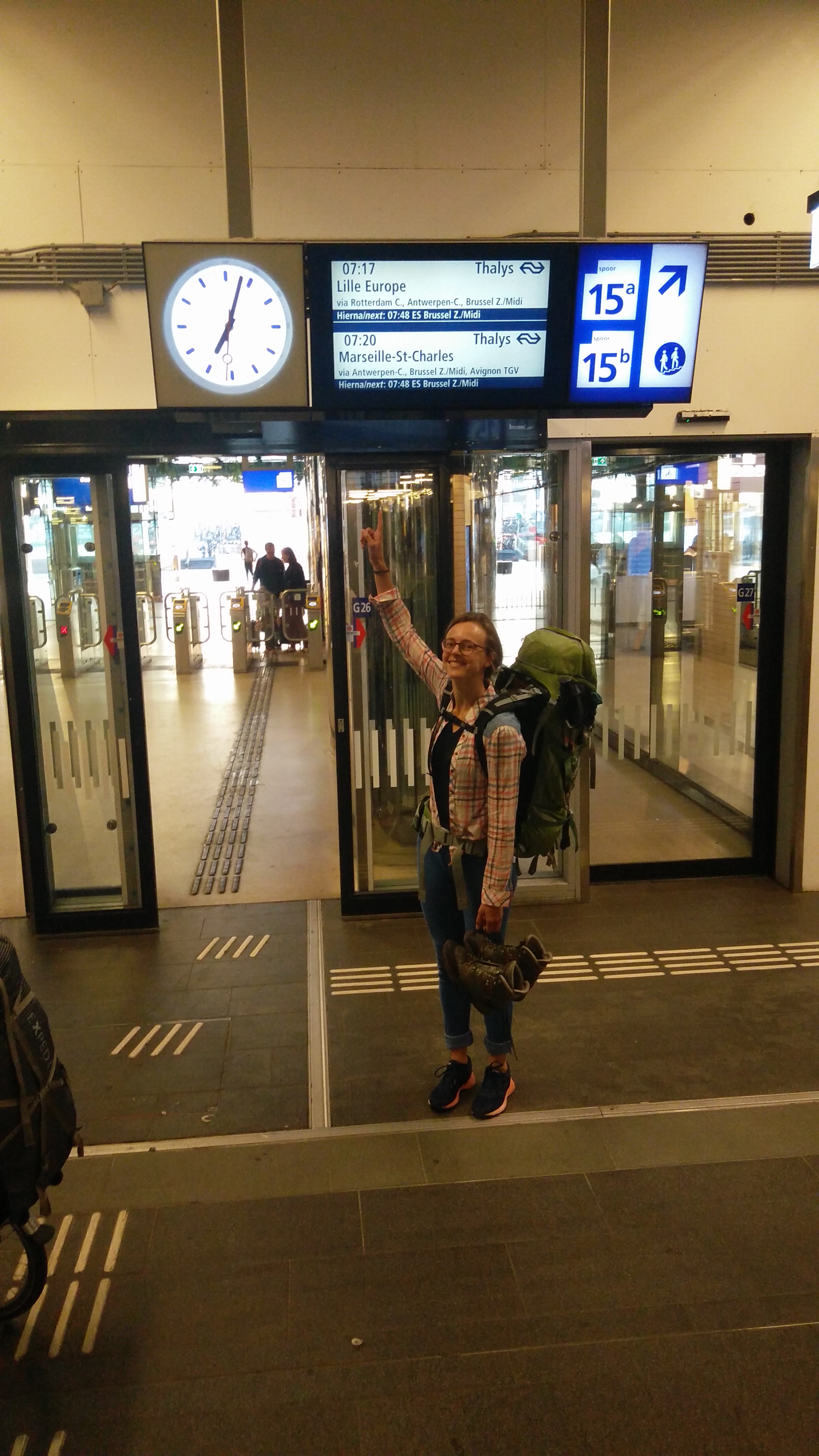
    We take the Thalys from Amsterdam directly to Valence: departure 7:20, arrival 13:00 (!!). Incredibly fast but the next train to Montdauphin-Guillestre is quite a bit slower and takes another 4 hours. Then a bus into the Querays. We leave the bus at Bramousse, where we enter on the GR58 and a short hike uphill brings us to the small village with its stone ovens everywhere. We are just in time for dinner at the Gite d’etape Le Riou Vert, joining the French in their cheese platter and sipping from Le Nebia, a local white beer (probably named after the misty clouds that often arrive from Italy’s Po valley in the afternoon).

    This trip we have ‘all’ our gear with us: tent, sleeping bags and mats, cooking gear, food for a couple of days, warm and waterproof clothes, water filter. Including water weight, approximately 2 liter on average, we have bags of about 17-18 (Ben) and 13-14 (Lisa) kgs. This is heavy but doable and makes us independent and free to go and camp where we want.


    Sunday August 19: Bramousse – Ceillac

    Today the real start of our tour. We leave Bramousse-village and go uphill, turning into the forest. A long path follows, passing by Bramousse-chalets and then finally we arrive at col de Bramousse, about 2,5 hours after our start. This is a nice grassy area where we finally see some other hikers, probably day hikers from Ceillac.

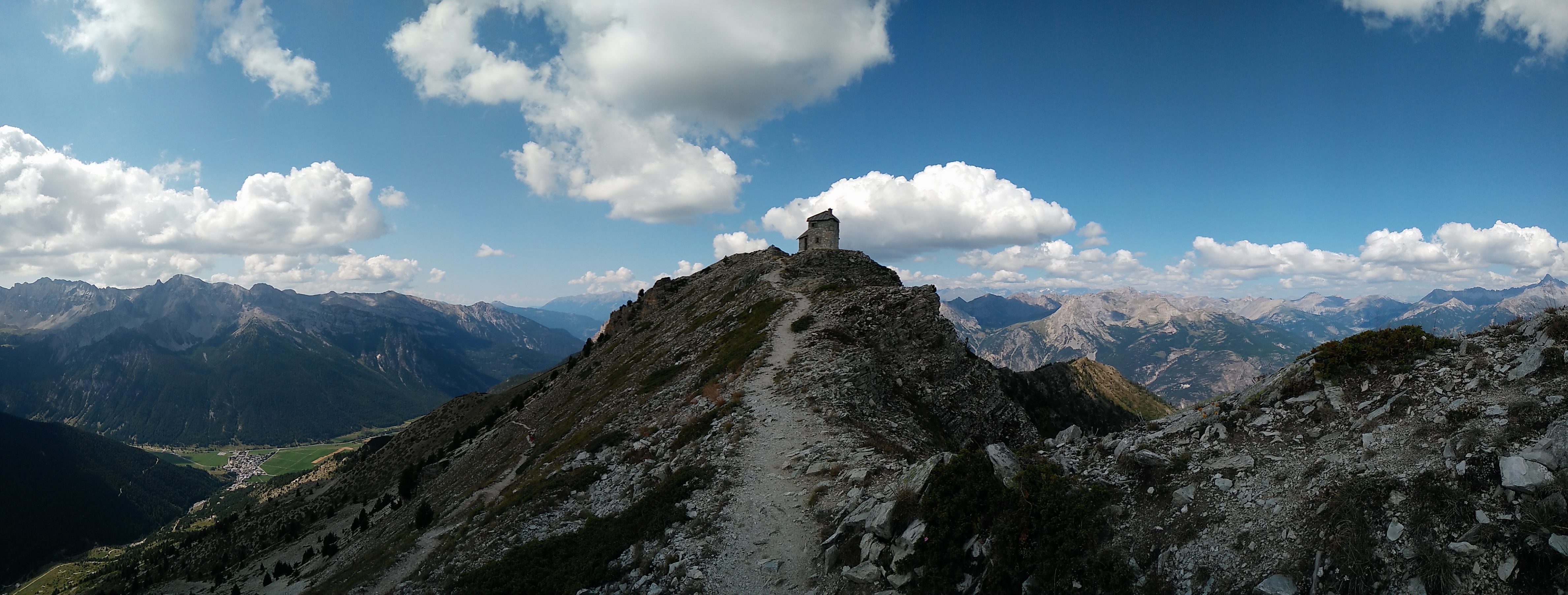
    We drop our heavy bags in the bushes and head towards the poste optique at 2580 m, an old mountain hut used for communicating across the mountains. This is really a magnificent place with great views on Ceillac and the valley of Arvieux towards Izoard. We return to our bags via the crête des Chambrettes, again with great views on both valleys.

    From the bags at col Bramousse it’s still quite a descent to Ceillac, but the weather is still great and it gets warmer as we descend. Ceillac is a charming little village, where we eat crêpes and drink orangina, and after grocery shopping at the epicerie we head towards the camping municipal. Here we spend the night for just € 8,10 for two persons, making pasta on our burner while having a great view on folks parapenting in the setting sun.


    Monday August 20: Ceillac – Saint Véran

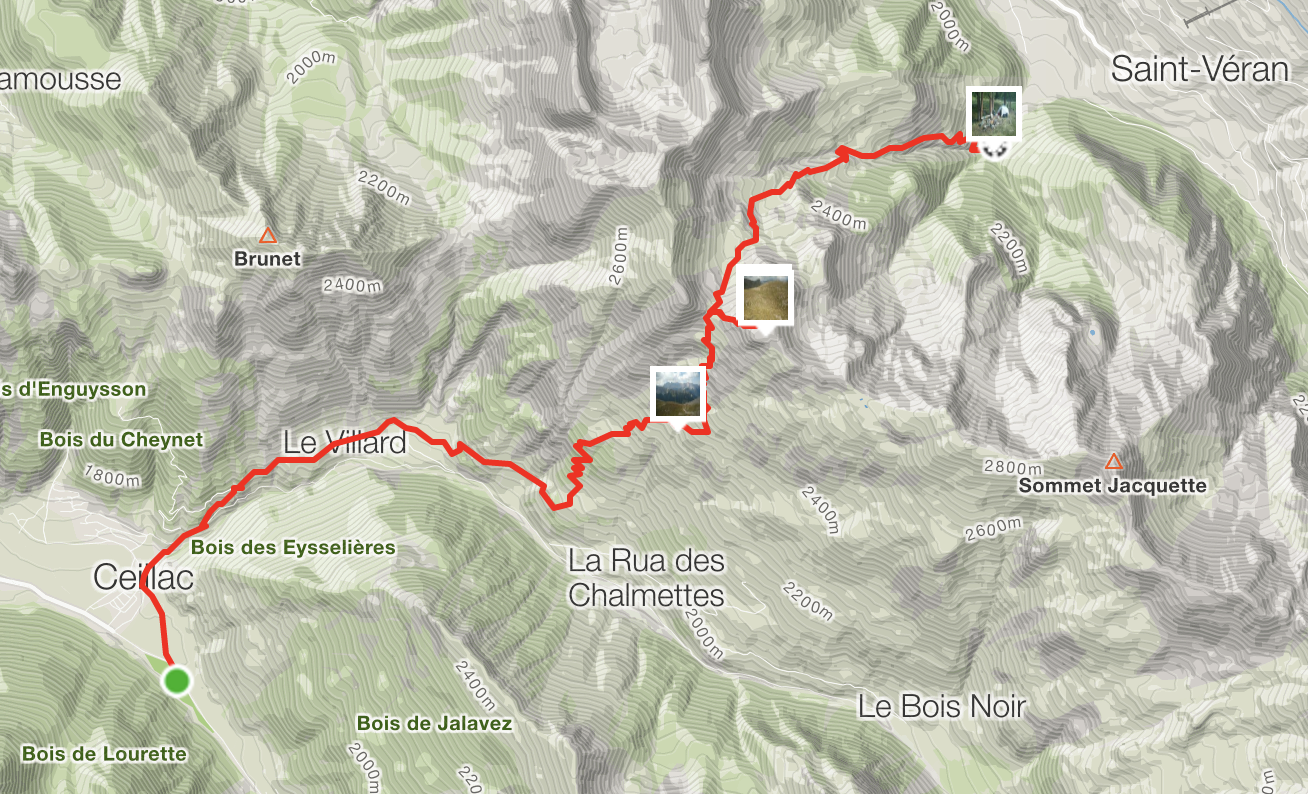
    We rise around sunset, 6:30, and enjoy Lisa’s homemade breakfast: cranberries, oatmeal, nuts, milk powder, cinnamon, which forms a delicious oatmeal when we just add boiling water. We head to the boulangerie in the village to get our lunch and then the day can start: St Veran via Tête Jacquette.

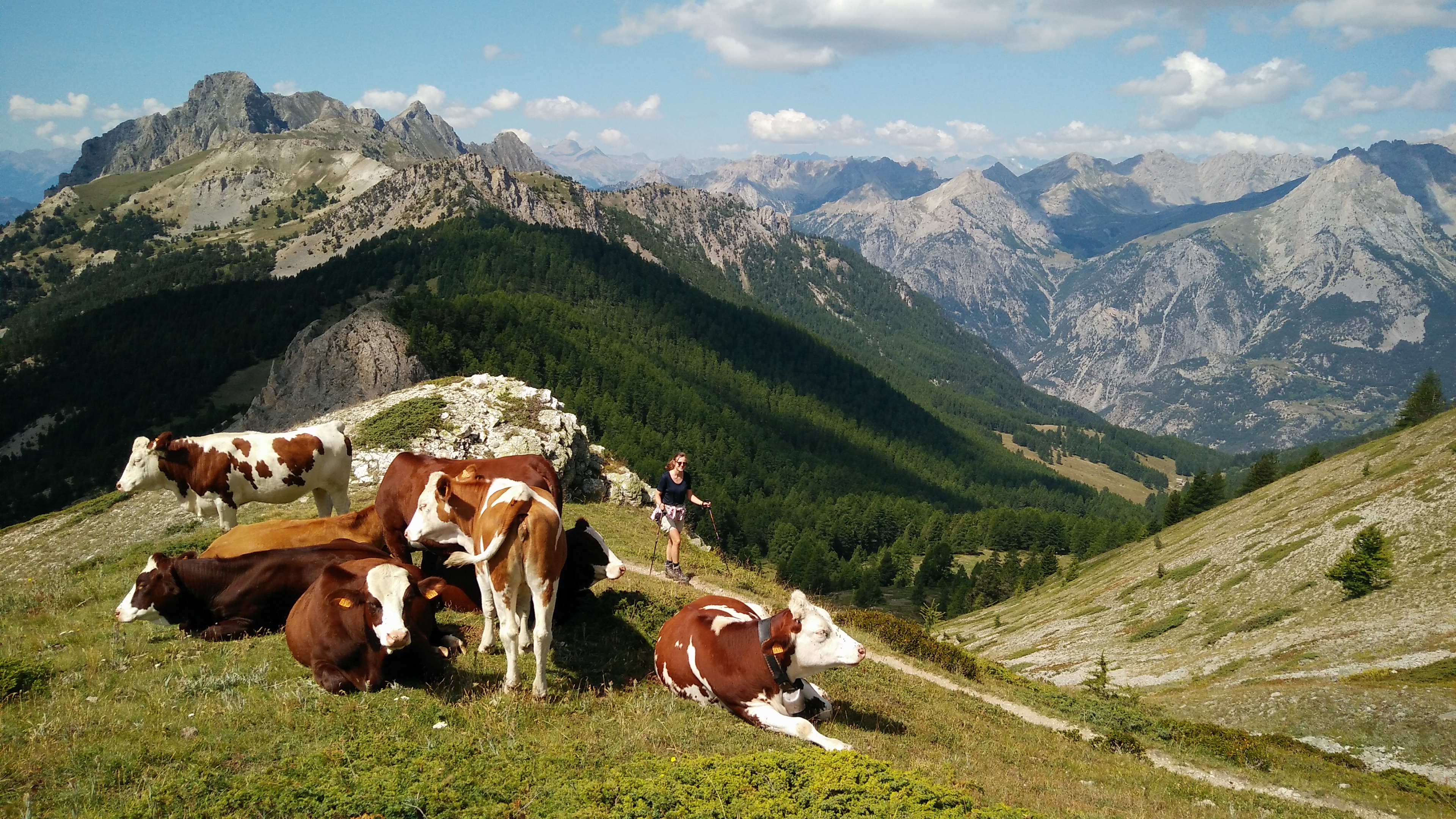
    This is a long and steady climb, quite steep and tough with our heavy backpacks. At the col des Estronques we have lunch – bread and sausage and tomatoes, and refueled we hike up the tête Jacquette (2757m) with little effort, as we leave the bags at the pass. The views from the top are stunning, from the Ecrins in the west until the Italian border in the east. Below us is the village of St Veran where we are heading to.

    After a long descent and aching feet we approach St Veran, but before reaching the river we spot a great wild camping spot where we pitch down the tent. It’s only 2pm but there are already light thunderstorms passing by with some rain. After this, the sky clears and we have a beautiful afternoon and evening, enjoying the river, making a campfire, and charging our devices with the newly acquired solar panels. We fall asleep with the sound of the river and wake up again next morning when it gets light – around 6:15.


    Tuesday August 21: Saint Véran – Col d’Agnel

    The daily morning breakfast routine and we hit the road at 8. A long gentle hike along the river of the Blanche follows, and along the route are more great wild camping spots.

    The weather is perfect, blue skies, and our first break is around 10am, with Chapelle Clausis in sight. We top up with fresh water, which we need for our noodle-style lunch later on, and continue the easy ascent towards col de Chamoussière.

    This area is filled with flowers, butterflies, some birds, and a enormous flock of sheep on the slopes higher up. But most of all, with their dominating sound, are millions of crickets, jumping up in swarms when we cross their path.

    Before the col we prepare warm lunch – noodles – although our burner has quite some trouble to stay alive. At the col, at 2880m, we decide we should hit the 3000m, which we do by hiking up Pic de Caramantran. With one foot in Italy we have a stunning view on the nearby valleys and mountains, although Monte Viso is hidden in clouds. During the descent to Refuge Agnel we get some light rain but nothing serious. At the refuge we have gateaux and cafe au lait, a hot shower and later in the evening we take dinner. Our tent is at some distance from the refuge, not so convenient but at least we have a quiet night. Our first time camping with the tent at 2600m!


    Wednesday August 22: Col d’Agnel – La Monta

    It’s still very cold when we wake up and we make breakfast in full outfits – hats, down jackets, fleece vests. Although the sun has risen, it does not show itself to us until about 8 am, when we are already packed and ready to go.

    The col Vieux is a short hike, 200m higher, and offers good views on the valley towards la Monta and Ristolas. We doubt about going up towards Pain de Sucre, at 3200m, but decide not do so given the long descent towards La Monta that’s coming up. The descent is indeed long but also very beautiful, probably the most beautiful stretch of the GR58 we have seen so far. We pass by the two lakes, Foreant and Egorgeou, and in the meanwhile see an ermine (black tail), marmots, many birds and flowers, and a big flock of sheep with several dogs, including two patous (protective dogs), and a shepherd.

    The views are superb and when we descend further we also get a belvedere on Monte Viso. In L’Echalp we arrive at lunch time but the gite d’etape is closed during lunch so we continue to La Monta. Fortunately the refuge is open and we have omelette with salads. We decide to stay at the camping in La Monta, which is nicely located at the riverside and with a super relaxed atmosphere. In the afternoon we enjoy the sun, local beer and then finish the day with pizza from the stone oven. The dining area is a couple of tables in the forest, and we are surrounded by three goats that are eager to get a slice of pizza, a couple of yurts that also serve as dining area, and a hot tub fired by wood. Quite a special, highly recommended place to stay.


    Thursday August 23: La Monta – Les Bertins

    It’s the first time we wake up after 7, and we enjoy having breakfast in the early warm sun. The camping sells fresh bread and croissants and with two scrambled eggs we have a wonderful breakfast for just € 3,60 in total. In general, the campsites here are cheap, the one in Ceillac and this one in La Monta cost us less than 10 € in total for a night. Not as cheap as wild camping but hey.

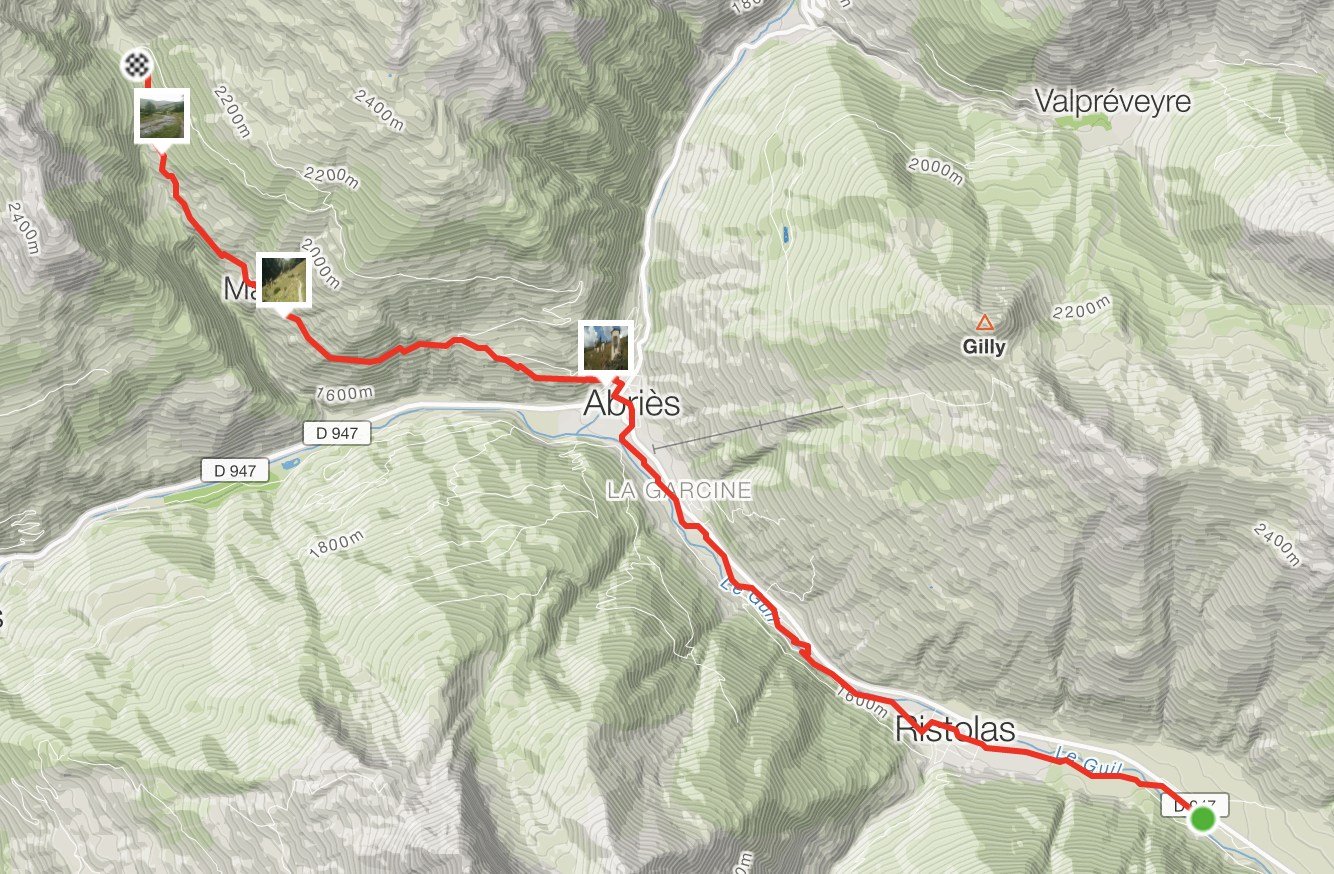
    The first kilometers are an easy walk to Abriès, a nice little village where we enjoy being back in ‘normal’ life, with café au lait and crêpes gelées mélezin (a sort of larch syrup), and the local supermarket Proxi where we stock up for a next night camping in the mountains.

    We leave Abriès by ascending in the village via the twelve ‘stones’ that lead to a chapel on the hill overlooking the village. It’s hot but the path is beautiful, full of flowers and insects and a panaroma towards Aiguilles.

    We pass by the settlement of Malrif, see a small snake crossing the trail, and then arrive in a valley surrounded by mountains, at around 2000m, called Les Bertins. The weather is changing and the first drops of rain are falling, so we quickly set up the tent to keep our stuff dry. After the rain shower has passed, its time for a (cold) bath in the river, and then for (river-cooled) beers that we carried from Abriès.

    We get disrupted by a rainstorm again, now much fiercer and with thunder. We find shelter in the tent and hope for better times. But the weather stays bad, and we have to stay in the tent for hours, with just a small window without rain in which we are able to cook some pasta outside the tent. When we go to sleep, the last rain is leaving the valley and the moon appears, blurred by the fully saturated humid air.


    Friday August 24: Les Bertins – Aiguilles

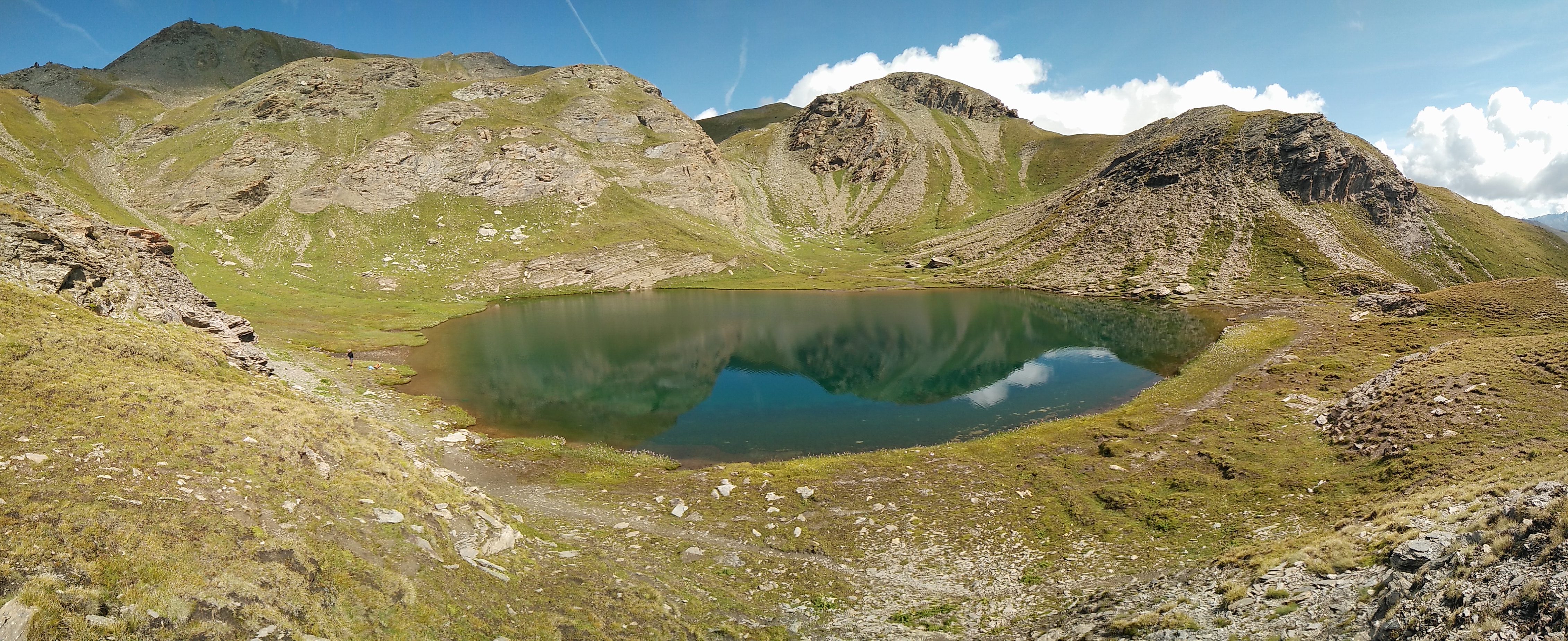
    Our sixth and last hiking day in the Querays. Clear skies but everything is wet and it will take time before the sun rises above the mountains. We just pack everything and start the climb to the lac du grand Laus, at 2579m. This is a fantastic climb with clear views of Monte Viso, and the clouds that are building up around it. It’s windy at the lake, but this apparently didn’t withheld some people from camping at the lakeside.

    After a break we continue to the smaller lakes Mézan and petit Laus (2700 m), where some people are fishing for trout. Petit Laus has crystal clear water and would be a superb wild camping site if the weather permits.


    During descent we encounter – again – a large flock of sheep, finding grazing grounds here above 2500m! We take their route down, but this is not well indicated and we spend some time roaming on the goat paths to find a way down. At least we see a golden eagle in the sky, being chased by smaller birds (alpine chough?) defending their nests. Eventually we decide to stop for lunch and let the tent dry. Here again we have great views over a large part of the Querays including the passes of Bramousse and Estronques that we conquered earlier.


    The last stretch towards Aiguilles is long and steep at times, with hundreds of colorful mushrooms along the way. In the early afternoon we arrive in Aiguilles, a little friendly village where we celebrate the completion of our 6-day hike in the Querays. We have delicious dinner – plat du jour: canard avec reine claude and Chardonnay from the Alps region – at Cour Voutée, a cozy restaurant in the center of the village. For the first time in days we enjoy a comfortable bed and shower in the highly recommended Yak Avenir, a cozy gite d’etape/hotel, where the very friendly owners help us with the trip back home.


    Saturday August 25 – the aftermath

    A long and refreshing sleep and homemade yoghurt at breakfast is a good start of our return trip which is a simple reverse of the trip a week ago. Aiguilles – Mt Dauphin/Guillestre – Valence Ville – Valence TGV – Amsterdam. We have some additional time in Valence which we spend having lunch at cafe Victor Hugo and shopping in the streets. The Thalys trip back is super comfortable, and will be a great option for future travels.

  • Iran – October 2017

    Iran – October 2017

    After great stories of friends and colleagues, the documentaries of Thomas Erdbrink, and curiosity for a land with few tourists, we decided for a non-standard option: Iran. Too be honest, we didn’t know exactly what to expect, but it turned out that this was going to be one of our best holidays ever. The phrase ‘meet the local people’ that we read in the Lonely Planet before departure turned out to be one of the most important things we did in our holiday, leaving a lasting impression even after we returned. It also surprised us how cheap the flight tickets to Iran are, how easy it is to get there (for example with Turkish airlines via Istanbul), and how nice the weather is in October/November. Two weeks turned out to be a short time, as always, but it is enough to see the main cultural-historical highlights of the country without being in a rush.


    Our trip started on Sunday, October 22. Departure at 12:30 from Amsterdam to Istanbul, then Istanbul – Tehran. Very good flight and meals with Turkish airlines. In Istanbul already we encounter first signs of Iranian hospitality, we get several suggestions for staying and eating in Iran and telephone numbers in case we need any help.

    At Schiphol: destination Tehran!

    We arrive late at Imam Khomeini airport, 22:30 local time. Lisa now has to put on a head scarf, which is strange and uneasy. We arrive at the visa office, which seems very unorganized and chaotic. It appears that we first have to get insurance (which we have been able to skip), then pay for the visa at the bank, then fill in a form, give it to a lady, who in turn gives it to a number of officers and then our passports disappear and the waiting begins. More than an hour later we finally get our passports back and are ready to enter. Maybe it took long because we didn’t apply for an E-visa? We don’t know but there are many other frustrated travelers.

    We are able to exchange some Euros to Rials at the departure level for a good rate and take a taxi to the city center (75000 toman, so 16 euro, which looks like a good deal). We arrive tired at our hostel, Persian Hostel, where we have a good night of sleep.


    October 23: breakfast at the hostel and into town. At Imam Khomeini sq. we buy a SIM card and then continue towards the Bazaar but not before getting freshly squeezed pomegranate juice. The walk towards the bazaar and the Imam Khomeini mosque is super nice and the weather is perfect, around 23 degrees and sunny all day.

    Pomegranate juice in Tehran

    After the mosque and part of the bazaar we get lunch at Timcheh Akbarian, which was hard to find, but worth the effort since we can lie down with dizi and bread and herbs, followed by tea.

    Afternoon is filled with a visit to the Golestan palace, a quite impressive place mostly originating from the Qajar rulers (19th century). Some rooms are filled with glass and mirrors and would go for kitsch by current standards, but clearly at that time it was to show the power of the rulers to foreign entities. The wind towers are amazing.

    Golestan palace

    In the evening we take the metro to the Tabiat bridge and have dinner at super friendly Khoone restaurant.

    Fantastic food and great beers at Khoone (‘home’)


    October 24: visit to the former US embassy (the ‘den of espionage’) is super interesting, including a tour in English.

    Anti US graffiti next to the former US embassy

    Close to the former embassy is the Iranian artist forum where we get lunch. We encounter more signs of Iranian hospitality when trying to exchange cash: a young guy on the street is super enthusiastic and eager to help us and wants to speak English as much as possible.

    Metro-hotel-metro and then bus to Kashan. Again people around us help us all the time in getting to the right bus. Kashaaan Kashaaaaaaaan even continues on the highway. Close to Kashan many people in the bus help us in getting a taxi, and eventually the father of one of the girls in the bus brings us home (and will be our driver in two days).

    Mosque in Kashan

    25 October: In the morning we visit the merchant houses, Tabatabae, Abassadi, Hammam. Incredible!! The hammam roof looks like the Tatooine planet from Star Wars.

    Sultan Amir Ahmad hammam

    Roof of the Sultan Amir Ahmad hammam

    The incredibly beautiful Tabatabae house in Kashan


    Afternoon is tour with Mahdi, our own driver, to underground city, salt lake, sand dunes + sunset, and the holy shrine of …? The surprise of the day comes when on the mosque’s square Benjamin gets a red (martyrdom) flag as a gift with the text, ‘ready for Imam Hossein’, ‘ready for Imam Mahdi’.

    Abbasi house, Kashan, like an Escher painting

    Mahdi explains his difficulties in getting a girlfriend: he needs a good job, a car, good family, and a house at the right place.

    Salt lake desert

    Curious camels

    Sunset in the sand dunes

    Lisa in her ‘tent’ (chador) at the holy shrine of Hilal ibn Ali


    26 October, Thursday: our driver, again named Mahdi, waits for us at the hotel.

    First Fin garden, then Abyane (great view from the castle), nuclear site, Natanz (mosque and superb lunch), and then to Esfahan. Our driver is not so good in English but he is a real entertainer and we have a great time.

    Restauration work in Fin Garden

    Beautiful women in Abyane

    View on Abyane from the castle

    In Natanz we pass by the mosque and the ceramic shops, but the highlight is one of our best kababs, including soup, drinks and rice, for just over 2 euro.

    One of our best lunches in one of the simplest restaurants.

    In Esfahan we take a simple dinner at a sort of Iranian fast food restaurant, we get more than we can eat for less than 3,50€ per person, including drink. A short evening stroll brings to the Jammeh mosque, where again we are treated with hospitality. First we get cakes (and spray) at a perfume store, then tea, wraps with cheese and herbs, and dates, when we pass by a parking lot.

    Hospitality is always around the corner – dates and tea at the parking lot


    October 27: It’s Friday: weekend. We transfer to another hotel, Isfahan traditional, and head into the city. The bazaar is almost completely empty. But then, suddenly, we arrive at the magnificent square, Naqsh-e Jahan. Quite likely that this is the most beautiful square in the world. It’s still quiet and the sun forces us to the shadow. We walk to the Chehel Sotoun palace, with the wooden columns and magnificent wall paintings from the Safavid era (?).

    Imam square and Lotfollah mosque

    Roof in Chehelsotoun

    Chehelsotoun palace

    Students at Chehelsotoun practicing calligraphy

    For lunch we have beryani, a local dish consisting of lamb minced meat inside a flatbread, and complemented with dough, a sour and salt yoghurt like drink with herbs.

    Then we go to the highlight of the day, the Shah mosque. Extensive restoration work is going on, including removing and repainting the tiles of the outside of the dome.When we are about to leave, the sun starts to set slowly and casts warm lights over the mosque. The square starts to fill with people, enjoying the last lights at perfect temperatures. While taking photographs, we’re approached by a women who is teaching English in Iran and wants her students to have a chat with us. A lively and funny conversation follows and we get yellow pudding and carrot juice.

    The Shah Mosque (Masjid-i-Sjah)

    We meet many more people on the square, including kids, all eager to ask where we come from and wanting to practice English. It feels a bit like being movie stars.

    In the evening we stroll along a very busy shopping street, look for watches and eat falafel in a packed fast food restaurant. We continue over the Si-o-se (33) bridge, along the river, and back over the Qaju bridge. There are people everywhere along the riverside, eating food or smoking shisha.

    Imam square just after sunset


    October 28

    Slow start today, to make plans for next days. Via bazaar we arrive at the Lotfollah mosque, a mosque missing some typical elements like minarets and presumably only used by the women of the Shah harem. The interior of the dome is a true highlight of our trip, showing brilliant symmetry and rich decorations.

    The breathtaking interior of the Lotfollah mosque. One of the major highlights of our trip.

    We take a taxi to Jolfa and have a great lunch at Firouzeh, next to the square: dolma with pomegranate sauce and an eggplant dish (borani bademjan).

    Dolma with pomegranate sauce and an eggplant dish (borani bademjan)

    Continue to the Vank cathedral, an Armenian Church, fully decorated on the interior with paintings from the old and New Testament, but also containing Islamic elements such as the dome and the tiled walls. The museum shows old gospels dating back to 11th century BC. The Armenian genocide is also addressed.

    Vank cathedral, a mix between armenian, christian and muslim influences

    In the early evening we are picked up by the girls from the English class and they take us to the Soffeh mountain for drinks and some snacks, including corn fresh from the barbecue. We have interesting talks and learn more about the Iranian way of living and the thoughts of the young people.

    Back at the hotel we take a stroll to see the Imam square for a last time. Unavoidably, we meet a group of young guys of our age looking to speak to foreigners. We take some ice cream (fesenjun?) and enjoy the conversations, even though it is sad to hear that these young people are quite pessimistic about their life in Isfahan and and would like to escape the country. With a slice of pizza we call it a day,

    Masjid-i-Shah at night

    Dessert on the street in Isfahan with new made friends


    29 October

    After administrative slowness at the hotel we take a cab to Kave terminal and the 10am bus to Shiraz. Traveling by bus is very comfortable and cheap. Arrival at Shiraz is just before sunset. We first go to Hafez mausoleum, which is very crowded with Iranians, paying homage to one of the countries most beloved poets.

    Hafez mausoleum

    Destiny in a poem of Hafez

    We then check out Persepolis trips at Parsian tourist agency and we go for a fantastic dinner at Ghayyam, with eggplant of course, before well deserved sleep at Niayesh hotel.


    October 30

    Early morning light passing through the stained glass windows in the prayer room of the Nasir al-Molk mosque

    Early start to see the morning sun in the ‘pink mosque’, the Nasir al-Molk mosque. The colors in the prayer room are indeed overwhelming, but so is the mass of tourists that is already present here. Especially a group of Iranian students make a lot of noise, which is quite in contrast to the relative peace and tranquility we have experienced so far in the historical highlights in Kashan and Esfahan.

    Courtyard of the Nasir al-Molk mosque

    The next highlight is the Naranjestan-e-Ghavam garden, also built for al-Molk.

    Somebody hungry for soup (close to the pink mosque)

    The Shah-e-Cheragh mosque we enter out of curiosity, although it takes some time before Lisa gets a chador and a guide necessary to enter. The premises consist of a new mosque, only 3 years old, in which prayers are going on, and an older part which contains the shrine of brothers Amir Achmed en Mir Mohammed, sons of the 7th imam. We take a long lunch break and chill in the nice cabins on the patio of the hotel. The waiter is rather impatient and forms a bit of a challenge, but in the end he’s quite friendly and funny and we get good and cheap food and a full pitcher of dugh.

    After a nap we set out for visiting another garden (Nazar) that includes the Pars museum, but this is not very interesting and could be skipped. Around the same time we have the first bad experience with a local, who tries to convince us to join him to some sight, and after friendly saying no to his request, he starts to swear. We walk through the bazaar, have some faludeh, look at rugs and camel bone boxes, but buy nothing eventually.

    We eat again at the hotel, since the food is so nice. We meet three Dutch boys who use our phone to get transport to Alamut valley and we meet two French guys whom we saw earlier in Tehran.


    31 October

    The impressive bas reliefs at Persepolis

    The wonders of Persepolis! With a minibus and a guide we visit Persepolis, about an hour ride from Shiraz. This is a tourist magnet but for a good reason. The staircase at Apadana palace leaves us speechless, not to mention that originally the bas reliefs were in color! Built around 500 BC by Aechemined kings, including Cyrus the great and Darius the great. The triple frieze which shows all the people of the Persian empire bringing tribute to their king is like a history book in pictures. The symbols show the significance of the religion of that time, Zoroastrianism, one of the oldest monotheistic religions in the world. The views from Persepolis on the surrounding mountains are impressive. What a pity that Alexander the Great burnt down the palaces, leaving only the ruins we see today.

    The typical symbol of Zoroastrianism, Faravahar, in Persepolis. Still a national symbol for Iran.

    The tombs of the Persian kings – Naqsh-e-Roostam

    In the afternoon we try to contact Bahman for a tour in the mountains and sleeping with nomads. But it’s difficult to get in touch, and we opt for plan B, spending the night in the village of Ghalat. We get a lift from Afshar Jowkar, who lives in Ghalat but works in Shiraz, and rents out an apartment in his house. He and his wife Zahar invite us for dinner and make us delicious bademjoon. It is super nice to be in their house, where scarfs are absent, and we can talk about politics, religion and so on. Afshar shows us their wedding video and plays guitar music, creating a nice and welcoming atmosphere in which we get a look into the life of Iranian people.


    1 November

    In the morning we walk to the historical village, also known as little Amsterdam, because of the free spirits who come here in the weekend from Shiraz. The village is now desolated and we continue to find a path into the mountains. After some trying we find a great path with a balcony Ike view in the old village, which is surrounded by trees in autumn colors. On the way back we pass by a waterfall where we meet two guys who offer us tea (which they carry, or course).

    Hiking around Ghalat village.

    After a nice omelette lunch in the village, we quickly find a local driver who brings us back to Shiraz, where we take the bus to Yazd. In Yazd we take a taxi to the Orient hotel, where we are lucky and have a VIP room. The French-Greek-Iranian owner of the nearby cafe de Paris prepares a great (beef!) burger before going to bed.


    2 November, Yazd.

    Lisa’s headache that started yesterday has become more serious and we take it easy. A visit to the artists house, the Jammeh mosque, and the water museum. In the fantastic mosque we are approached by a family who asks is if we want to come to their place in Mehriz the next day (Friday, so weekend), which we kindly accept.

    Jammeh mosque and preparations for ash (soup) marking end of mourning.

    Rooftop dinner at Baam cafe – great view, food so so.

    Alleys in Yazd

    Seyed Rokn Addin Mausoleum


    3 November

    Breakfast in our hotel in Yazd.

    In the morning we walk to the Zoroastrian temple, finding the same symbols that we found earlier in Persepolis. Then we take a taxi to the wind towers, a somehow mysterious place where deceased people where not buried, but given back to nature by having the he bodies being exposed at the top of the towers and being eaten by vultures.

    On top of the towers silence – burial ground for the Zoroastrians.

    The taxi then brings us to family Salek, where we are very kindly treated with fruits, and the with lunch, khorest sabzi.

    Family Salek in Mehriz.

    We have a last cup of tea with fantastic view on the mosque.

    Amir Chaqmaq complex

    4 November

    At 6 the taxi driver wakes us, small communication mistake, but we quickly get ready and around 6:40 we are at Yazd airport. The security check is hilarious, Lisa gets checked in the women’s section and is ‘touched’ on some peculiar places, while suitcases are piling up just after the entrance.

    In Tehran we arrive at the domestic airport and take the metro to Tajrish, from where we take a taxi to the hotel (150000). We then go for lunch to Chez Vous, where we have the best cappuccino in Iran so far, in the first hipster-like place that we visit, run by a couple of friendly and somewhat shy guys.

    Best coffee in Chez Vous in Tehran

    With a taxi dar baste we go to the Tochal ski lift, where a big disappointment waits: the lift only operates Tue-Fri. As alternative we go for a hike up the mountain, which surprisingly turns out to be much more interesting and rewarding (and potentially dangerous) then initially thought.

    View on Tehran


    After our hike, we take a taxi to Darakeh, a village in the north of Tehran, to have dinner. Our last hotel is nearby and luxurious, we have an upgrade to a junior suite because the normal rooms are occupied.

    5 November

    We have nice breakfast and easy start of the day, before we take the metro back to the airport and the flight back to Amsterdam.


    Our most intriguing observations:

    • We met many Iranian girls who don’t want the hejab (head scarf).
    • So many people want to learn English!!!
    • Political opinions… most say that Rouhani is better than Ahmedinejad, but still disliked.
    • We see quite some young girls with nose corrections.
    • Young people find it difficult to get a job, they want to get out of Iran.
    • Iranians are proud of the martyrs of the Iran-Iraq war, there are portraits at many places.
    • Iranians are very calm in public areas such as metros.
    • Iranians keep new things, like chairs and tables, in plastic (so it stays ‘new’?)
    • We see few people reading books or newspapers (at least not in public)
    • Steps on stairs in old buildings are extremely high
    • No toilet paper, just use water
    • Iranian traffic is a nightmare and looks like a total chaos
    • Iranian queueing is very much like Iranian traffic. Whoever is most assertive and least afraid goes first.
    • Iranians don’t mind if you don’t buy from their shops or if you don’t enter a sight because you think it’s too expensive.

    Our best Farsi:

    • Salaam
    • Chetore
    • Khodafez
    • Az didanet Khosbakhtam
    • Khosh maze
    • Merci, mota shakkeram
    • Ziba, aali
    • Gorbe
    • Chand toman
    • Dah hezar toman? Panj toman? Etc
    • Geile khub
  • Pyrenees, August 2017

    Pyrenees, August 2017

    Day 1, Friday 11/8: early rise in Amsterdam, we take the Easyjet flight at 7:20 to Toulouse. Gate M lounge area looks like a chicken farm but at least the tickets were cheap. Upon arrival in Toulouse we have a Blablacar to Lourdes, from which two bus rides finally bring us to Gavarnie. After buying a map we’re ready to hit the trail around 14:30.

    Day 1: Gavarnie – Bujaruelo

    Quickly the superb Cirque opens up in front of us, and we see hundreds of tourists taking the road towards the waterfall. We take a higher route with few people and marvellous sights. After steady climbing for about three hours, passing the cabane des Soldates, we arrive at the port de Boucharou. We see cattle and marmots along the way and many beautiful flowers.
    On the pass it’s windy and we quickly start our descend – we try to get to Bujaruelo in time for dinner so we speed up a bit. Hunger is kicking in, wine gums are swallowed like water. Fortunately Bujaruelo is in the civilized world and there is a restaurant where we can eat a la carte (!). A well-deserved hot shower concludes the day.

    Day 1: Cirque de Gavarnie

    Carline thistle (zilverdistel)

    Day 2, Saturday: slow start, recovering from yesterday’s headache. Plan is to do the Ordesa canyon and continue to Goriz. An ambitious plan as we later see.

    Day 2: Bujaruelo – Goriz

    First part of the hike is easy, through forest along the river side, before arriving at the junction to Torla and the start of the Ordesa canyon. Here the touring cars pass by to bring tourists to the canyon. We dip in the ice cold river and enjoy the lamb chops that were leftovers from yesterday’s dinner. Then we take the high route towards an incredible viewpoint, Mirador de Calcilarruego.

    Day 2: view from Mirador Calcilarruego

    Descend towards end of Ordesa canyon

    After the mirador the route has stunning, continuous views on the other side of the canyon. Slow descent to end of canyon and a final climb to Refugio Goriz at 2195 m, where we arrive late (8pm) but in time for the last dinner shift at 10. Tired but satisfied with more than 25 km hiking and over 1000 elevation meters. Camping is free here but quite crowded and noisy; many Spanish are going to Goriz as a weekend trip. Nice dinner with a Spanish couple from the Pyrenees and an older experienced Frenchman. Sausages are saved and kept for tomorrow’s lunch.

    Day 3, Sunday: we take a ‘relax’ day: leave luggage at Goriz and ascend to Mt Perdido (3350m), third highest peak of the Pyrenees.

    Day 3: Goriz – Mt Perdido – Goriz

    The weather is perfect, and no need to leave early. We leave around 9, and a beautiful ascent follows, over a rocky boulder field to the (not frozen) Lago Helado and then steeply the final stretch to the summit. Two steps forward, one step backward. The view from the summit is a stunning 360 degrees. Some clouds are setting in but there is time for lunch: sausages left over from last night’s dinner. We descend the same way back but much faster by sliding down a snowy slope. In Goriz the bathroom facilities are basically non existent, but the food is decent, and the view on the canyon is superb. We have early dinner at 7 with friendly Spanish couple from San Sebastián.

    On top of Mt Perdido

    Refugio Goriz

    Day 4: After quite a good night of sleep we are ready early for the final stage back to Gavarnie via Breche de Roland.

    Day 4: Goriz – Gavarnie

    The weather is again great and quickly we take off the jackets. We reach a beautiful meadow where some people have been wild camping. We meet with Isabelle and Christophe, who accompany us on the path to Breche de Roland. We take the lower approach and later see in the distance the high route which follows a breathtaking cliff guided with ropes.
    The Breche is crowded with people, many take the route from Col des Tentes (car park) to Boucharou and then up. We traverse the Breche and after lunch descend via the refuge (closed for construction works) and then an alternative and long way down along cascades to Gavarnie.

    Early start at Goriz

    The Breche in view

    Approaching the Breche

    Snowfield at the Breche

    Refuge Sarradets / Breche de Roland

    The way down from the Breche to Gavarnie

    Edelweiss

    Dinner in Gavarnie

    In Gavarnie we find a nice camping spot at the bergerie, with views on the Cirque and the cascade. Well deserved beers after 4 days hiking, 60 km, and several 1000s of elevation meters!! In the evening the tourist flood in Gavarnie disappears and we have a very nice and calm dinner at restaurant les Cascades with good wine from the region, finishing with cheese.

    Day 5: Gavarnie – Toulouse

    On our last full day we travel back to Toulouse. The bus from Gavarnie doesn’t go, it is a public holiday (Assumption of Mary). We take a taxi to Luz St. Saveur with two friendly Indians, then switch to the bus to Lourdes, where we have booked a Blablacar to Toulouse. Lots of fun in the Blablacar with an Ethiopian couple, who show us proper Ethiopian music. In return we offer Dutch music (Guus Meeuwis) and Ontbijtkoekreep, which are almost mistaken for space cake.

    In Toulouse we visit the famous Basilique Saint-Sernin, and at the moment we enter an organ concert starts, the dramatic Toccata & Fugue from Bach filling the entire church. After a visit to the Capitole and a stroll through the city and the river banks, we settle for great dinner at La Braisière. An excellent conclusion to an excellent holiday!

    View from our camping

  • Chile, 10 March – 3 April 2017

    Chile, 10 March – 3 April 2017

    Departure on Friday evening, Amsterdam – Buenos Aires – Santiago de Chile. Just before arrival in Santiago we have a great panorama on some high peaks of the Andes. In Santiago we spend a day with Dutch-Chilean friends who take us for great almuerzo (lunch) with chelada (beer with lime and salt) and subsequent city tour. It’s sunny and close to 30 C, the jet lag is easily forgotten.
    On Sunday back in the plane, to Puerto Natales. Beautiful flight over the Andes and view over the Lake District and a couple of volcanoes. Cloudy when getting into Patagonia. Arrival in Puerto Natales, goretex city of the south! Our friendly host Columbus receives us with tea and shows us around in the city. Last supplies – gas – and we’re ready to go.

    Monday morning, hikers gathering at the bus station at 7:30. Two hour bus ride, we see condors circling, and then arrive at a ridiculous queue at the park entrance for filling in forms. A next bus brings us to Camping Torres. Strong winds but the new Hubba Hubba tent does a great job.

    We get lunch from the mini grocery shop and set out for the hike to the Torres Base viewpoint. A long hike but with mind blowing view when up at the mirador. It’s a bright day and the sun casts shadows of the towers on the lake. The hike back is tough and we arrive just before sunset.

    After a rainy night we pack the wet tent and set foot again, now for a less ambitious goal; the Los Cuernos refuge. But first: self made oatmeal as breakfast to start the day. And a second encounter with Chilean bureaucracy when trying to book a glacier hike on Friday. Rest of the day remains cloudy and with light rain, but at least much better than forecast. In Los Cuernos we pitch the tent on a platform and fill the bellies fully with the provided dinner.

    Wednesday starts gorgeous with the sunrise coloring the mountains pink right in front of us.

    A long day ahead: Los Cuernos – Italiano – Britanico – Italiano – Paine Grande, almost 23 km. The landscape is quite different, we walk over white stoned beaches along the lake, turn onto a green meadow, and then into the cold forest at Italiano.

    We leave bags at Italiano when going to the Mirador. First glacier Frances reveals itself on the left, and what we thought last night to be thunder appears to be ice breaking off the mountain leading to frequent avalanche shows. The view is absolutely magnificent.
    We continue over a ridge, mostly through forest, and arrive at a boulder field with fantastic views on the surrounding mountains. Crossing the field and a last steep climb leads us to the mirador. 360 degree views on the Torres, the Cathedral and Castillo peaks, and many more.

    Surrounded by mountains. 

    After the long day of yesterday, Thursday is an easier day with less climbing and only 11 km to Refugio Grey. Half way we see the first blue icebergs on Lago Grey, telling that something grand is coming. And yes, a little later we arrive at the stunning mirador, with the full Lago Grey in view, ending (starting) at a giant sea of ice.


    Early arrival allows us to go to the glacier viewpoint and to arrange ice hiking for the next day.

    Friday early rise and assembly at Bigfoot base camp. With the zodiac to La Isla and hike to glacier. Crampons, helmets, harness.. ready to go. This is an unforgettable experience- we have a great view on the glacier, go through a tunnel in the ice, and awe at the blue streams flowing on and through the ice.


    In the evening back in Puerto Natales.. where there is pizza and wifi to plan the next days.

    Saturday bus to Punta Arenas. The landscape becomes empty and desolated. We see condors, lamas and flamingos. There are seats available on the plane to Puerto Montt in a few hours which we decide to take. Lisa eats ‘pollo a la pobre’, an enormous amount of fries, chicken, onion and eggs. In the air we have an incredible view on the Andes and see the Perito Moreno glacier (which we decided to skip) in all its glory, and the Fitz Roy mountain range.


    In Puerto Montt we rent a car from a Dutchman who likes talking and stay in the city in a room of a house of two friendly elderly people. In the local bar, Cirus, we sit with the owner Luis at the table who shows Chilean hospitality by offering us wine and local sopaipillas, while we get huge pieces of salmon with lime, too much to finish.
    Sunday we enter onto the one and only Carretera Austral and we slowly leave civilization behind, although we enter a world of endless ‘cabanas’ advertised along the road. Parts of the road are gravel and limit us to 30-40 km/h. Poor rental car. There is no boat in Hornopiren today so we get supplies (fuel, food, cash) and go chilling in the termas de Pichicolo. The surrounding rainforest is incredible and we see nice birds in the area; hummingbirds, a kingfisher, black-neck swans. Hornopiren itself is not interesting and mainly features ugly cabanas. Even the horses look depressed. As in all cities so far dogs are abundant.

    Monday 20 March, we get to the ferry, where gigantic pie is sold for just 2€. A double ferry ride of about 5 hours brings us to Caleta Gonzalo, entrance to Parque Pumalin. Walk to cascade covered in a LUSH (LP talk) rainforest, green everywhere. Camping is a little paradise, very well maintained and with few people.


    Tuesday, breakfast with blueberries, freshly picked. Then the alerce trail with trees of more 3000 years old. Lunch and hike to El Chaiten volcano, which erupted in 2008 and is still smoking. A very hot day and a tough ascent, like a long staircase.

    In Chaiten we get supplies (gas!) and book a ticket for the ferry from Balmaceda to Chiloe. Nice tarmac road to Amarillo, where we take a left turn back into the park. We get stuck with the car but with some serious efforts. Great dinner at camping Grande where we are the only people besides a Chilean couple who offer us some delicious Queulat wine in return for using our corkscrew.

    Next morning Lisa headache maybe due to the walk in the sun. Today will be driving day and we have time. Great route via La Junta (pie limon) to Puyuhuapi (failed to send out postcards) and then to national park Queulat, with the hanging glacier (Ventisquero Colgante). The friendly camping guard Matthias explains about the birds (hummingbird, hued-hued, cuchao, kingfisher) that we saw the days before and at night takes us to the lake which reflects the stars. Full milky way and no moon. But before that he makes us fresh bread from the oven in his cabin behind the duchas.

    Thursday we planned to stay another day in Queulat but weather looks cloudy so we pack and head out to Coyhaique. An incredibly scenic route with glaciers, rivers, forests, and hairpins on gravel roads. It is like Yosemite but without the tourists and with glaciers. We also see some lamas. Coyhaique is not so interesting but we finally find a post office and get some good food, ceviche and tartare patagon. We camp in Mañihuales at a house where time stands still and an old man enjoys the sun in front of his house. There are no other campers. We enjoy a camp fire and Chilean Ventisquero rojo and hot showers.

    Life on the carretera Life on the carretera

    Next morning mystic sunset due to the fog. Fresh hot bread from the mercado. Back over the hairpins and on time for road closure at Queulat. After Puyuhuapi we get into a drift due to the loose gravel and do a 180 on the carretera. Everything OK but car in hopeless position. With sheer luck the carabineros arrive, and a little later a couple of 4x4s are pulling out the car from the ditch. They disappear as fast as they came and miraculously everything still works and no visible car damage. We take it easy towards La Junta and have lunch (learning that guadittas are stomach) to calm down. Then the gravel road to Balmaceda, a little village which does not seem attractive at first sight but which appears to be a stunning place once the sun breaks through the clouds and we make beach walk accompanied by dolphins in the river.

    Saturday early rise, strong winds and some sun, we take the boat from Balmaceda via Melinka to Quellon on Chiloe. We are the only ‘normal’ car on the boat and we see mainly truckers and some families and some tourists including a Dutch lady traveling through Chile for many months. We see an otter upon leaving but in the remaining 9 hours on the boat we don’t see the blue whales that are swimming here close to the pacific coast. We arrive on time in Quellon and take Miguel, an Italian hitchhiker, to Castro. It takes some effort to get a bed and food but finally we are ok.

    Start of PanamericanaSunday morning we have fantastic breakfast in cafe el Puente, French toast, poached eggs, sencha tea, yogurt and fresh fruits. We visit the wooden church, where service is going on.

    We continue to Quemchi in search of Curanto, the local Chilote dish, but Quemchi is deserted. We continue via Ancud to Quetalmahue, where we find the magic dish, containing shellfish, mussels, chicken, sausage, pork, potatoes. It’s tasty and it’s a lot… almuerzo and dinner at once. Nearby supermarket is from another era. The penguins have left the national penguin monument but the pacific coast is still worth a visit and we find a cozy cabana at the sea side. The use of wood heating is very common here, the smell of burnt wood is everywhere in the streets in Chile (and probably not so healthy).

    Monday 27 we get up and go for a walk along the coast, and still see some last penguins. The road back to Ancud reminds of the English countryside; hilly and grassy with cows. The coast is rough like in Scotland. We travel back to Puerto Montt to hand in the car, and continue on the bus to Osorno. In Osorno we connect to Bahia Mansa, where we seek information on boats to Caleta Condor, a paradise on the coast only reachable by boat or 2 days hiking. We meet Patrick Lightfoot, who offers to help and a stay in his (dirty) cabana. What follows are incomprehensible stories: pumas attacking tourists on the trail, banjeros robbing them and throwing them in the sea, his job as Los Angeles police officer, as helicopter gunner in Iraq, at the CIA, the previous owner of his house who worked for the Mossad, the watch of Eichmann, the war between Mapuche and Chilean government and him supplying weapons, and his plans to start helicopter flights in the area for adventure tourism. Error. Next day it turns out his talks indeed are idle and he has nothing arranged for us to go to Caleta. The fishermen are not very eager to help and so our efforts strand. Here off-season tourism is absent and would require advanced planning that we didn’t do.

    We take the bus back to Osorno and continue directly to Pucon. The Caleta deception is easily forgotten, as we find a camping at the lake, completely for ourselves, with full sunshine, set against the picturesque volcano Villarrica that we want to climb on Thursday. Wednesday we have a very relaxed morning and in the afternoon go to the Peumayen termas, which is nice but not very special. In the evening we get our stuff ready for the vulcano climb next day. At night we get heavy rains but the Hubba doesn’t care, we stay dry.


    Early morning the sky is clear and we have good hopes for the climb. The gear (crampons, pickle, helmet, sledge) is ready at Aguaventura and so are we. But clouds have appeared on the vulcano and after about one hour drive, at the ski station, the sun set reveals many clouds on the mountain and the trip is cancelled. In the evening we take the night ‘cama’ bus to Valparaiso – but not before we have visited the nice Trawen restaurant in Pucon once more for salads and cakes.
    The last days in Chile in Valparaiso are a dream. Great weather, and views over the city. A great place to stay (Morgan). Good dining (Apice) and ceviche. Visit to the beautiful house of Pablo Neruda. Shopping in the streets of Cerro Allegre.


  • Lanzarote, 27 nov – 4 dec 2016

    Lanzarote, 27 nov – 4 dec 2016

    Sunday morning: early rise @ 4am, then 6 am flight Amsterdam-Arrecife. Easy car rental, and we head southward to Playa Blanca where we have the first stay.

    After lunch easy and beautiful walk along the coast line, alternating beaches and rocks, to Playa Papagayo.

    Monday we figure out diving and walking options and head to Timanfaya, the island’s tourist magnet, and for a good reason. The bus tour, even though we have to stay inside, is amazing and the number of calderas is stunning. The tricks with the geysers, burning wood and hot soil are clearly one in a row, but still impressive.

    Next is the scenic drive to El Golfo, including the salt basins and the Lago Verde lagune, green due to algae formation, and the rough shore tormented by waves.

    Walk along the coast through the lava. Fresh fish for dinner concludes the day.

    img_20161128_173258

    Tuesday: early rise and to La Geria, the islands wine region, producing great wine that we already approved at last nights dinner. Nice hike around and on an old caldera (crater).

    schermafdruk-2016-12-05-21-50-27

    The omnipresent stone circles contain, surprisingly, the wine trees.

    img_20161129_095259

    Although the first impression of Lanzarote was a black volcanic landscape with little life, we slowly start to discover many beautiful plants: aloe vera, fig trees, cactus, grapes, agave.

    Afternoon session Lisa goes for discovery dive as preparation to join tomorrow’s dive to Flamingo wall.
    Lisa on first dive

    Wednesday: diving day! Morning session to Museo Atlantico, the underwater museum of Jason de Caires Taylor. Impressive and very topical, with statues of Lampedusa refugees. See lifegate.com.

    The afternoon dive at Flamingo wall is beautiful, with big schools of fish, reefsharks, groupers, and many more. In the evening arrival at Haria in an old house partially rented out via Airbnb. Nice tapas dinner in Puerta Verde.

    Thursday is surfing day. Back on the hairpin road with views on Haria and towards Caleta de Famara.

    img_5804

    After board and wetsuit rental it’s time for wave riding, which Lisa succeeds at; Ben gets some lessons from an instructor who sees him suffer. The scene: a continuous wave train feeding the hungry surfers, set against the breathtaking cliffs just a stone throw away.

    img_2799

    After being tormented for some hours, back in the car with trembling arms. Teguise is the coffee stop for today, a delightful town with streets flooding in warm sun light.

    img_20161201_153208

    We continue to the north, passing by a small wind park, and arriving at Mirador del Rio. Great views on Isla Graciosa, our home for the next days.

    Friday morning. Sad to leave the beautiful apartment in Haria. We set out for a hike towards the cliffs.

    schermafdruk-2016-12-05-21-48-35

    We pass by some goat farms, but they are deserted. Upon arrival at the cliff, fantastic views towards Famara and Isla Graciosa, at least as good as from the Mirador. And no single human being on the path so far.

    We go off track on a steep climb and then meet three man cutting mushrooms on the slopes. Afternoon trips to the Cueva de los Verdes and the Jameo del Agua, both consequence of a 7 km cave system created by solidified lava flows. The number of tourists sharply contrasts with this morning’s hike. But, the artist Cesar Manrique has created a small paradise including restaurant and auditorium. As we continue to Orzola the Sahara wind colors the sky brownish. Arrival at Isla Graciosa, with a warm welcome by Steve, whose sail yacht is our house for the next 2 nights.img_20161202_180432

    Saturday starts rainy, and more rain is promised. We leave anyway for a hike around the north of the island, after visiting the panaderia for bread and the ferreteria for everything else you might possibly need (ponchos and the like).

    schermafdruk-2016-12-05-21-52-13

    Weather improves during the hike, and after having passed the tiny village of Pedro Barba we walk again in solitude for several hours. The great lava show has taken place here, too, and the white sands strongly contrast with the black stones. After 12 km the stunning Playa de las Conchas (shell beach). At 18 km back in town, tired legs and well deserved beer in the hamburger bar where El Classico is on display. Great cheering when Real scores last minute equalizer. A boat deck shower, a chat with Steve, and fajitas with salsa for dinner end our last day.

    Sunday travel day. Ferry at 8, car in Orzola and easy ride to Arrecife. We have a hitchhiker from Germany who is very happy to join us. The second day with rain is the island’s message that its time to go home.

  • Corsica – GR 20 Nord, 14 – 22 June 2016

    Corsica – GR 20 Nord, 14 – 22 June 2016

    Stage 1 – Vizzavona – Refuge de Onda

    Early flight AMS – Ajaccio. Train Ajaccio – Vizzavona. Buying fuel for on the way: bread and sheep cheese.

    Route stage 1

    Long stretch through the forest, before the climb to 2100 m starts. From the summit Onda is visible but descent is still long and very windy. Arrival at dinner time, just in time. Cold and windy shower, and then the snoring orchestra in the dorm. Bienvenue a GR-20!

    Lisa at highest point stage 1


    Stage 2 – Refuge de Onda – Refuge de Petra piana

    Easy stage, we leave late. At breakfast the first Frenchman is already having wine and sausage. It appears to be extremely windy at Petra piana so we take the low route. Pain et saucisson along the way at a lovely bergerie. The weather in the valley is great and we enjoy the sun and bathing in the river.

    Route stage 2

    Upon arrival at Petra piana it appears that a lot of tents have been blown away or torn apart due to the extreme winds. We’re lucky that we sleep in the cabin and the wind has calmed down.

    Stage 2

    Breakfast for next day is picked up after dinner. Idyllic location with magnificent view although cabin is small!

    img_20160615_193054


    Stage 3 – Refuge de Petra piana – Refuge de Manganu

    Difficult and long stage, though one of the most beautiful.

    Route stage 3

    After an initial climb on a rocky path we arrive at a windy saddle. Cloud patterns are different every day and an absolute dream for a meteorologist.

    Panorama

    Then, suddenly, a magnificent landscape unveils.

    View on the lakes

    We cross several snow fields even though it’s end June and we’re at around 2100 m. The sticks help to poke in the snow and spot potential holes.

    Snow path   Sioux

    Lunch at a beautiful spot, shielded from the wind, together with the Fellowship, many birds, and Corsican delights. More highlights follow; the Sioux, the three sisters. The final climb to the ‘keyhole’ consists of chains and almost vertical rock faces.

    Vertical rock climbing with chains

    We’re just in time back before fog sets in. Dinner is pasta which disappears in seconds after the photo was taken. The refuge owner is an enthusiastic guy and calls me Benji. Let’s consider it a compliment.

    img_20160616_184112


    Stage 4 – Refuge de Manganu – Hotel Castel de Vergio

    Breakfast for Benji readily picked up at the refuge – we spent the night in one of these superquick Quechua tents, quite small and uhhh small.
    After breakfast we head out, as usual we’re one of the lasts to go. But the stage will not be too difficult, and the arrival will be at a hotel (yes a hotel) with a proper bed and all other good things in life.Route stage 4

    We’re not there yet and the first thing we discover when we walk down the river that we’ve been situated in a stunning green valley that was not visible yesterday due to the fog.

    Valley close at Manganu

    We arrive at a beautiful bergerie, where there is – surprise – cheese and some bread. There is only a single man here at the bergerie, together with his dog and cattle, and he looks perfectly happy in this silent and beautiful corner of the world.

    …where the time has stood still

    We continue and arrive at some meadows and lakes, another bergerie (which we skip), see more horses and cattle and take lunch at the shore of a lake. Just too cold to swim but still – this is a very idyllic place.

    img_20160617_120500

    After lunch we speed up and via a small climb we arrive at a crest along which we have  great view on the surroundings. The wind seems to blow steadily from one direction.

    Lisa and the tree

    The descent through the forest is relatively easy but we are seeing fata morganas already, so eagerly wishing warm shower and good food.

    The hotel! It’s real and it’s great. After refueling at the local store we have a serious dinner for two with real BREAD and VEGETABLES. It’s amazing how 4 days can turn simple things into heaven.

    img_20160617_192904


    Stage 5 – Hotel Castel de Vergio – Refuge de Tighjettu
    Route stage 5Having seen cars and many living beings again it’s not difficult to get on route again for day 5. The route goes through the forest and then into more open area with a nice river and tempting pools. But the day will be long and we save the pools for later.

    A climb out of the valley leads us to a refuge where we have lunch – omelettes! Upon departure the sun has disappeared and we need full equipment on, including gloves. A long and steep, difficult descent follows. Like most of the GR, there is not really something you can call ‘the path’, its more just the mountain as it is with some paint on some rocks. This is tough for the knees, even with the sticks that we use.

    OLYMPUS DIGITAL CAMERA

    The steep descent is followed by a never-ending stretch through the forest, and eventually we arrive at Auberge U Vallone. From here it’s still a climb to Tighjettu, which becomes visible higher up in the mountains.

    Tighjettu is quite a place to be, not in the last place due to the friendly owner who has decorated the place as if it could be a party place (as last according to the signs).  Dinner is spaghetti, lots of spaghetti, but when it’s still not finished we decide to take the remainders for next day’s stage.

    All talking is about tomorrow’s weather, which might be bad – rain, possibly thunderstorms. We have to take a the difficult route via the … since the old route via Cirque de la solitude was closed in recent years due to stone slides. Decision is to rise early and leave at dawn, around 5:30, when it’s light enough to see and atmosphere still calm.


    Stage 6 Tighjettu – Haut Asco

    route_etappe6After a bad night of sleep (Ben ending up on a mattress in the dining area as a consequence of deprivation of oxygen and overdose of snoring and heat), we head out early together with the Fellowship, the red cavalry, and Cameron, the friendly Californian who can be a bit pessimistic – ‘rain will come, it has been decided’. We – the light weights – make good progress, and rather unexpectedly arrive within 2 hours at the pass. Clouds have been rising from the valley in beautiful patterns, while we climb out of it.

    img_20160619_073247

    Given we’re fast, we decide to take the round trip to Monte Cinto, the highest point on Corsica. But the route is much longer and more difficult than expected and half way we hesitate to continue, also given that clouds have surrounded us from all sides, making the weather unpredictable – still afraid for thunderstorms. In the end Cameron passes by and convinces us to continue – ‘the blind leading the stupid’ according to Cameron.

    OLYMPUS DIGITAL CAMERA  img_20160619_102436

    The summit is, disappointingly, surrounded by clouds, so the view is close to zero – except for some precious moment with blue spots – nicely photographed by Cameron – and Mars bars. The descent goes rather quick but is not easy.. although his photo looks like an easy walk in the park…:

    Lunch at the bag spot, then the long and tough descent to Haut Asco. Full rain gear is needed and we’re crossing along snow, slippery rocks, but also incredible views. Last nights backup spaghetti is a ‘warm’ welcome to give us fuel for the last kilometers. We’re happy when finally the ski village of Haut Asco appears, with our ‘own’ room, tea and pie, and dinner in a normal restaurant.


    Stage 7 Haut Asco – Carozzu

    route_etappe7

    Today’s stage promises to be a little easier and like usual we take breakfast when everybody has left already. The main issue for today are the Spanismata slabs at the end of the stage, which, when wet, are extremely dangerous to cross.

    Lunch is at a small lake just after the highest point of the day.

    img_20160620_135038

    The slabs are dry when we cross so we’re lucky. When crossing the footbridge we take a dip in the river. The refuge is around the corner but rain comes and the refuge is cramped. At dinner, weather improves and we have an amazing sunset with view on the Mediterranean.


    Stage 8 Carozzu – Ortu di u Piobbu

    route_etappe8

    Bad stomach vibes today makes this stage one to remember. In any case, after the initial climb to the pass, we have wonderful views all around and try to spot the mountain goats – mouflons – to no avail. The path along the crest is superb. Mt Cinto lies far away, surreal that we climbed just some days ago.

    During descend, it becomes warmer and we get closer to the normal, inhabited world. The refuge of Ortu di u Piobbu lies at an amazing spot and we opt for a tent instead of the bunk beds, best choice of the week.

    img_20160621_161940

    Goodbyes to the Fellowship, they almost choke when we tell them the Fellowship designation we have given them.


    Stage 9 Ortu di u Piobbu – Calenzana 

    route_etappe9The last stage gives us mixed feelings. Happy to go back to normal beds, food, warmth and dry conditions, but missing already the peace and quietness of the mountains. Day starts strange with stolen breakfast.

    While we descend, it gets hot, very hot, something not experienced during last week. We get back in a different climate zone. Views on Calvi are stunning.

    img_20160622_094809

    Arrival in Calenza is unreal; houses, people, cars. In the one restaurant of the village we meet – of course – the fellowship and the red cavalry. Pizzas made in heaven are well deserved. We made it!

    img_20160622_140844

    A short taxi ride to Camp Raffali, where we first take a dive in the Mediterranean, the big blue pond that was teasing us for many days. It is so divine that we miss the last train and find a hitchhike with two boys that is faster than the train and more dangerous than the last 9 days. We survive and arrive: Ile Rousse!

    The aftermath

    9 days of limited comfort is enough excuse to enjoy luxury for days. We take it easy and enjoy north Corsica and Italy. Food is great, and so are the sun, the sea, and the people. Exit canistrelli, enter ice cream.
    img_20160623_121517Train to Bastia, we spend the night and morning sightseeing, then take the ferry to Livorno.

    img_20160625_105627  img_20160625_102850

    Delays make we arrive late in Lucca, but we enjoy a great last night anyhow on the anfiteatro plaza. Last full day is sightseeing Lucca, sightseeing Pisa, and then a delayed flight back to Amsterdam.

    img_20160625_155213

  • Kilimanjaro for War Child – 21 January – 6 February 2016

    Kilimanjaro for War Child – 21 January – 6 February 2016

    The prequel

    In September 2015 the idea rose to climb Kilimanjaro as fund raising activity for War Child, after seeing an ad in the newspaper. Slowly enthusiasm grows after attending an information event at the headquarters in Amsterdam. Only issue is the trip to Canada, which starts 8 February, so I need to get in group 1 in order to make it to that trip.

    Minimal fundraising target is 2400 euro. Cost of trip and flight ticket and gear etc are own costs. First step fundraising: email, facebook, etc. This already brings me close to 2000 euro due to very generous gifts. Second step: organization of classical music concert! VondelCS, former film museum, is so kind to rent out their venue at almost no costs, and colleagues Latifah Hamzah and Helmar van Santen are the stars on violin and cello.
    Part 1 – warming up on safari 


    Part 2 – climbing the Kili